
Date: November 8, 2025
The operational success of any UK restaurant hinges on far more than just excellent food and service; it relies critically on the performance and compliance of its HVAC systems. For commercial kitchens, ventilation isn’t merely about comfort—it’s a non-negotiable legal requirement directly impacting UK food safety, fire risk, and regulatory compliance.
Restaurant owners and managers must navigate complex standards to ensure their premises are safe, compliant, and efficient. Failure to meet these standards can lead to hefty fines, insurance voidance, and even forced closure.
The UK Regulatory Compass: Compliance is Key
In the UK, commercial kitchen ventilation is governed by a stringent framework designed to protect staff, customers, and the building structure itself. Compliance extends beyond simple air exchange and focuses on fire safety, hygiene, and air quality.
Key Compliance Standards to Know:
- DW/172 Specification for Kitchen Ventilation Systems: This is the industry gold standard set by the HVCA (now BESA) and specifies the design, installation, and commissioning of commercial kitchen ventilation. It mandates specific air volumes, ductwork materials, and FOG (Fats, Oils, and Grease) filtration requirements.
- The Regulatory Reform (Fire Safety) Order 2005: This regulation places a duty on the Responsible Person to ensure all fire safety precautions, including regular cleaning and maintenance of extract systems (to prevent grease build-up), are in place.
- Food Safety and Hygiene (England) Regulations 2013: These regulations require adequate ventilation to control temperature, humidity, and eliminate condensation, smoke, or fumes that could contaminate food.
Meeting these standards requires specialized commercial kitchen extract systems designed by experts.
Critical HVAC Components for Regulatory Compliance
A compliant restaurant HVAC system must be a balanced equation between air extraction and air supply. Below are the critical components and their compliance focus:
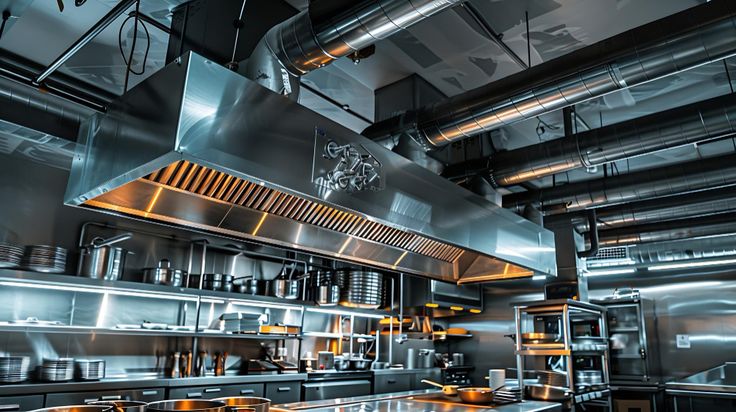
- Extraction Canopy & Hoods: The focus here is efficient capture of heat, steam, and grease-laden air. They must be appropriately sized for the cooking equipment below, directly impacting Commercial kitchen extraction efficiency.
- Grease Filtration: This is essential for fire prevention and duct protection. Multi-stage systems (e.g., baffle, carbon, or UV-C) are increasingly common. Key terms include FOG filtration systems and kitchen ventilation fire safety.
- Ductwork and Access: Ductwork must be welded, sealed, and have sufficient access panels for mandatory cleaning and inspection. This ensures adherence to standards like DW/172 compliant ductwork.
- Supply/Makeup Air: Replacing the extracted air is critical to maintaining neutral or slightly negative pressure, preventing draughts, and ensuring system balance. This is often referred to as Commercial kitchen makeup air or a balanced ventilation system.
- Fresh Air Intake: The system must draw air from a location free of contaminants to ensure high indoor air quality (IAQ), a key aspect of Restaurant IAQ standards.
The lifecycle of these systems—from design and installation to quarterly cleaning and maintenance—must be documented and verifiable to satisfy local council and fire service inspections.
The RankLift Media Advantage: Connecting Expertise with Opportunity
For specialist HVAC companies that possess the expertise to design, install, and maintain these complex, compliant systems, the challenge is not capability—it’s visibility.
In today’s market, UK restaurant owners search for specialized solutions, using long-tail keywords like “HVAC compliance specialists London” or “restaurant ventilation service DW/172.” If your expert service doesn’t appear when they search, your expertise goes unnoticed.
This is where RankLift Media puts its role and proves we are the best partner for your growth. We specialize in helping niche, ambitious B2B service providers, like high-end commercial HVAC contractors, turn digital attention into measurable, high-value contracts.
Our Strategy for HVAC Success:
- Targeted Content Strategy: We develop content that ranks for high-intent, niche-specific terms, positioning you as the authority on UK food safety ventilation and regulatory matters.
- Performance-Driven SEO: We optimize your online presence to capture leads searching specifically for BS EN 16282 or commercial kitchen fire safety solutions, ensuring your site outperforms competitors.
- Measurable Growth: Our focus is on aligning your digital presence with your business goals, driving qualified enquiries that convert into contracts, helping you dominate the market for HVAC for restaurants compliance.
Your team focuses on keeping UK kitchens safe and compliant. We focus on ensuring the restaurant owners who need your expertise can find you first.

Conclusion
Achieving UK food safety and ventilation standards is not an option; it is a legal necessity for every restaurant. This process demands a high level of technical proficiency from the HVAC provider.
Restaurant Owners: Prioritize selecting a contractor who demonstrates proven expertise in DW/172 and fire safety compliance. Their proficiency is your protection.
HVAC Specialists: Your deep knowledge of compliance is your greatest asset. It’s time to ensure your digital marketing reflects that expertise. Partner with RankLift Media to turn your regulatory mastery into unmatched business growth.
Published by RankLift Media – Turning Digital Attention into Measurable Growth.